Writing · 2023
Gezi and Its Afterlives
Failure, melancholia, and trying the outside world again.
Gezi and Its Afterlives
Failure, melancholia, and trying the outside world again
The story of how we were defeated
Ever since I read Colectivo Situaciones’ 2007 text “Politicizing Sadness” written years after the 2001 insurrection in Argentina had failed, I have been haunted by this one paragraph. It goes like this:
Sadness arrived after the event: the political fiesta-of languages, images, and movements-was followed by a reactive, dispersive dynamic. And, along with it, there arrived what was later experienced as a reduction of the capacities of openness and innovation that the event brought into play. The experience of social invention (..) was followed by a moment of normalization and the declaration of the “end of the fiesta.” Among us political sadness often took the form of impotence and melancholy in the face of the growing distance between that social experiment and the political imagination capable of carrying it out.
The collective witnessed the changing interpretations and moods around the event which seemed to be over for good. The hot days of the alter-globalization movements were drawing to an end, the momentum was ebbing –which we all felt in one way or another. I recall perceiving a sense of familiarity with the weight of the emotions described in this paragraph, even though I had never experienced such a political climax and generational failure. Yet deep down inside, I was no stranger to it; I have always felt it in some way. Today, I am much more aware of why.
Hopelessness, says the late David Graeber, isn’t natural.
It needs to be produced. In the last thirty years we have seen the construction of a vast bureaucratic apparatus for the creation and maintenance of hopelessness, a kind of giant machine that is designed, first and foremost, to destroy any sense of possible alternative futures,
he writes. Where I come from, the 30-year spanning apparatus of despair Graeber talks about had been installed in the aftermath of the 1980 coup d'état. This coup did not only put a neoliberal mechanism to work but also physically destroyed a whole political generation and mentally subjected future generations to come to the dictum that "there is no alternative." According to Tanıl Bora, behind this political impotence lies the decadent and pessimistic attitude of "sustainable cynicism." Social criticism and analysis no longer focus on the here-and-now of politics but instead cling to a certain bygone past, sustaining the state of collective inertia. Such politics seems to have lost its sense of possibility and astonishment; it speaks only in the language of defeat.
And then the wall came down.
Enzo Traverso, meditating on the defeat suffered by the left in the aftermath of 1989, writes that
it ended a century and summarized in itself a cumulative sequence of downfalls that, suddenly gathered and condensed in a symbolic historical turn, appeared as overwhelming and unbearable […] What remains of this century of “storming heavens” is a mountain of ruins and we do not know how to start to rebuild, or if it is even worth doing.
In “Resisting Left Melancholia”, Wendy Brown criticizes this intimate yet public feelings of defeat experienced by the Left. She condemns “a Left that has become more attached to its impossibility than to its potential fruitfulness, a Left that is most at home dwelling not in hopefulness but in its own marginality and failure.” For Brown, left melancholy is a persistent condition, a state, indeed, a structure of desire, which made the Left not only live in a perpetual past but also in a cynical present, unable to formulate alternatives.
In Turkey, this ever-growing state of political incapacity led the new generations, those who were not crippled by the loss of the social experience of the 1970s, into a deep sense of hopelessness and powerlessness. Referring to Marianne Hirsh's concept of “post-memory”, it can be said that my generation lived the social trauma not by remembering it but by reflecting and investing in it. This political trauma was overcome not through ethical and political acts as Hirsh suggests, but by relying on a cynical attitude towards politics. It seemed like we have all shouldered that “great historical weariness at having spent too long rubbing history against the grain” as Daniel Bensaïd suggested.
Nevertheless in 2013, something unexpected, something unasked for happened. In order to save a park from demolition, the whole country rose up. It arrived in the true sense of an event. It seemed to burst forth out of nowhere, it felt like it had no precedent, and looked and tasted like nothing before it.
Annie Ernaux, in “The Years” describes how May 1968 felt as follows:
“Now we were aware that something was happening and did not feel like returning to life as usual the next day. We met by chance and talked, indecisive, and then came together. We stopped working, for no specific reason and with no demands to make, but simply because we’d caught the bug, and when the unexpected suddenly occurs, there is nothing to do but wait. What would happen the next day we didn’t know or try to find out. It was another time.”
She continues:
“In order to think, speak, write, work, exist in another way, we felt we had nothing to lose by trying everything. 1968 was the first year of the world.”
Gezi was newness itself; it was the beginning.
At the heyday of the uprising, Yiğit of the Express magazine interviewed Foti. His words captured the affective state of the Gezi Park occupation with precision:
You have probably read in books that in this kind of revolutionary situation or moments of uprisings, a state of solidarity where people gain a sense of pride that empower and beautify them arises. Everyone helps and protects one another. Indeed, you start believing that human beings have inherent tendencies to live as social beings, and to organize their social life together with their fellow human beings. This was revealed to us in this process, which is the most valuable gain we made. People realized that they can be powerful collectively. This feeling will probably stay with us for a long time.
That feeling indeed stayed with us throughout the years of state violence, legal persecution, and increasing repression that followed the uprising. Yet, ultimately, the political fiesta-of languages, images, and movements-gave way to a reactive, dispersive dynamic.
I encountered my own words in the pages of the catalog of an exhibition titled Unexpected Territories held in 2016:
The present, however, is the time of the counter-revolution. It is a genuine Thermidor. And as Daniel Bensaïd states, every “recurrence of Thermidor has always bolted the door of possibility whenever it has been opened just a fraction.” As that door of possibility is being closed, a sense of defeat spreads. Something has been lost, something is missing, and something has become “the past.” An emergent yet familiar “structure of feeling” is shaping up: melancholia and political depression, the feeling of an impasse, and the inability to start something new after waging a war against the powers that be.
The text ends with a quote by Ernst Bloch, from the Principle of Hope :
Precisely the defeated must try the outside world again. That which is coming up is not yet decided, that which is swamp can be dried out through work.
These two sentences lingered in my head over the past decade and became my mantra of political survival. The experience of defeat sharpens the critical insight of those who are defeated and transforms their capacities of action, Traverso argued. Today, wiser, I know the same.
I would like to tell you a story—hopefully a political autobiography of those who went through myriad political failures and defeats. I would like to tell you how one endures against what seems like relentless repression and violence and survives. It is a non-defeatist story about defeat; it is a story of political agency and collective care and endurance.
Mind you! This is not an oriental story taking place in a faraway middle eastern land of despotism. This is the very present of authoritarian regimes and capitalist crises everywhere and peoples’ common struggle against them.
Notes on method
In 2016, my comrade Fırat and I conducted an interview with historian Peter Linebaugh. We asked him what his work on past social struggles taught him about defeat, wondering if he might have some tips for us who were feeling a little lost after Gezi. He answered as follows:
Yes, this period is partly a period of retreat. I honestly don't know what to do today, But I know that today is definitely the time for the mole to go underground. The British Marxist historian Christopher Hill was my teacher, a great historian who studied the history of defeat in the 17th century. Hill's research shows us that despite the defeat, these people tried to spread messages of hope through allegories, myths, and even reinterpretations of religious stories. In times of defeat, it is necessary to create spaces that will allow us to maintain our social reproduction and sanity. I think what we need to do as historians is to constantly record the changes in people's lives and thoughts, to create an archive through interviews and documentaries. This is a really important historical experience.
Inspired by Linebaugh's humble suggestions for survival, Zeyno got pregnant. Later on, Zeyno and I started a Project titled “After the Event.” We delved into the afterlives of the 2010 global uprisings to reconstruct the events through the bulk of images they left behind. Conceptually and methodologically, the project was inspired by the works of Kristin Ross on May 68, as well as the Paris Commune. The notion of “the afterlife” which questions how the event is represented and discussed in its aftermath became crucial for us. We looked at different forms of narrativizing and framing the event and analyzed the struggle between the official histories and the collective memory of the grassroots movements.
In preparation for this talk, I revisited all that I wrote over the past 15 years: academic articles, commentaries, op-eds, interviews, diaries, sketches, and audio-visual recordings. I returned to my bedside books and articles that I had become obsessed with. I conversed with my comrades, reread texts they had written, and watched the videos they had made. In so doing, I wanted to try writing a “collective autobiography” of a political generation.
The beginning
Bu daha başlangıç mücadeleye devam (“this is just the beginning, the struggle goes on”), the motto of the Gezi uprising, was chanted by people long after the uprising failed to deliver on its promises. The slogan never really articulated a clear political demand. It was rather a wishful statement about the future of the struggle: that it should go on. It did not have an identifiable subject pronoun. Bu (this) only signified the specific time and space of the utterance. At whatever moment the slogan was chanted, it was to signal a new beginning.
So, what was it that had begun?
“The event is a movement in the flow of time,” wrote Şükrü Argın in 2022, trying to come to terms with the eventfulness of Gezi on its 9 th anniversary. Relying on the difference between the linearity of historical time and the circularity of the time of the event, he pointed out that the potential of the uprising was to be found in the regime of temporality it brought about.
In 2017 I wrote, passionately:
In the first week of June 2013, a passerby walking from Sıraselviler Street to Taksim Square or approaching Gezi Park from Elmadağ, would be greeted by two banners: "To the Taksim Commune" they declared. A few days before these banners were put up and exactly 142 years after May 28, 1871, the day when the Paris Commune was evicted, one of my comrades, standing on the makeshift stage set up in Gezi Park, announced, "We continue, comrades!" and greeted the Paris communards. The slogan "This is just the beginning, the struggle goes on" which students, workers, young women and men chanted continuously for days and nights, sometimes on the barricades, sometimes walking the streets arm in arm, during May 68 in Paris, was translated into Turkish a few years prior: "Bu daha başlangıç, mücadeleye devam."
If the history of the oppressed is not written linearly like that of the sovereigns but rather unfolded in leaps across time and geographies, then, in that June, gazing from Taksim Square towards Gezi Park, you could sense the mourning for the fallen comrades of May 1, 77 in Taksim and the Paris commune, feel the taste of tear gas from a canister fired simultaneously in Sao Paolo, the uncanny air in Tahrir Square in that very moment, and the silence of the Armenian cemetery on which Gezi park was built.
So, it was not a linear beginning. It was more of a circular understanding of time and temporality that gave the uprising its political potentials. As past, present, and future collided, one found herself at the edge of all possibilities. Each moment embodied the density of a century, and histories of the oppressed spoke to one another.
In an Art Performance titled “At the Edge of All Possibilities,” Zeyno described those mundane moments that seemed to last but a second as follows:
We felt like we lived under a different regime of temporality: for the first time, we comprehended the motivations of the 15th-century rebels Sheikh Bedreddin and Börklüce Mustafa, and for the first time I felt profoundly “contemporary”. It was an epoch of global uprisings; we were part of these trembling times.
In “Theses on the Philosophy of History”, Walter Benjamin talks about the “now-time” to describe a notion of time that is ripe with revolutionary possibility; time that has been detached from the continuum of history. It is a time at a standstill, filled with energy, and ready to take what Benjamin called the ‘tiger's leap’ into the future.
I never felt so belonging to a place on Earth, I never felt so “coeval”– I felt “up to the moment”
I cannot pinpoint exactly when this feeling of coevality faded away, or when we gave up chanting the slogan “this is just the beginning”. In 2015-2016, tens of violent attacks, most of which were claimed by ISIS took place in different parts of the country. Simultaneously, the Turkish Army started military operations in the Kurdish towns of Amed, Cizre, and Nusaybin, killing hundreds accused of engaging in terrorism. On 15 July 2016, a fraction within the Turkish Armed Forces, attempted a coup d'état, the failure of which was followed by a prolonged state of emergency.
In 2018, Altyazı magazine organized the screening of In the Intense now by the Brazilian director Salles. The documentary invited us to look into the past by focusing on the 1968 revolution. Salles says his film was after “that ineffable emotion that follows the shock of the unlooked-for encounters.” I was very aggravated by the film and labeled it defeatist, as to the extent it sublimated the “now”, it detached the “moment” from history, action, and the collective subject.
I was particularly triggered by how Salles interpreted a piece of footage taken from William Klein's Grands Soirs et Petits Matins, in which young people working in a coordination center sweet-talk the mother of an activist over the phone:
Even though I fiercely opposed the film’s political narrative, this one sentence lingers in my mind to this day: “They may never be this happy again.”
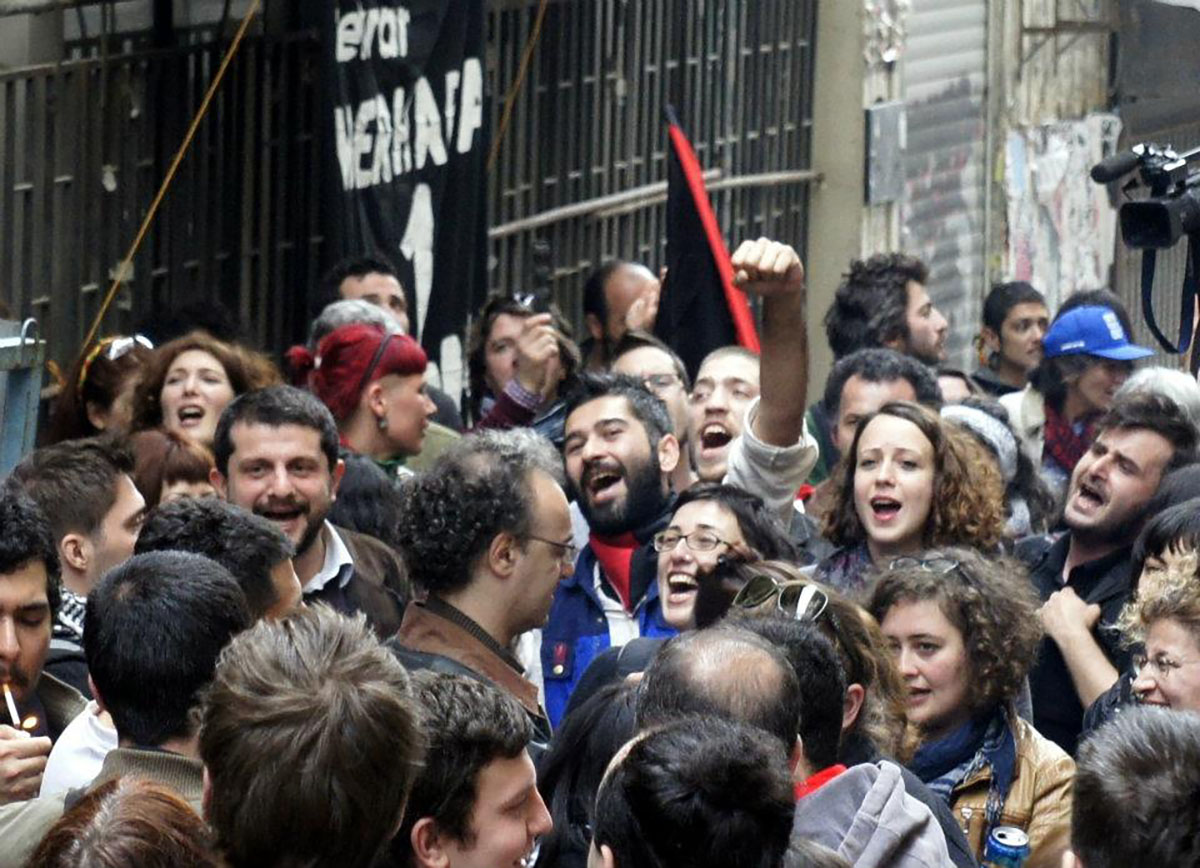
The image that stuck to these words in my mind was a photograph taken on Mayday in 2011 in front of the gates of the Emek movie theater. It’s me encircled by my friends, comrades and an ex-boyfriend, smiling and shouting a slogan, which may as well have been “this is just the beginning.”
I still keep thinking, “will we ever be this happy again?”
Presentism and the production of uncertainty
For Jodi Dean, unlike Brown, melancholia does not arise from an inability to critically engage with the present reality due to a libidinal attachment to the lost object of 20th-century communism. Dean suggests instead that melancholia stems from a failure of the Left to reassume a commitment to proletarian struggle after existing communist projects were contingently defeated. Yet both takes on the nature of left melancholia argue that it is the Left’s “fault” that it cannot free itself from a bygone past and reflect on the state of the “present.”
Yet what if that present is produced in such a way that creates an impasse and impotency, and what historian François Hartog calls the presentist regime of historicity. Hartog's notion of a “regime of historicity” invites us to reflect on how the universal categories of “past”, “present” and “future” are articulated in different historical periods. According to Hartog, “1989” marks the end of the “future-oriented” regime of historicity which began in 1789 that was based on the promise of the conquest of the future through national progress. In turn, the fall of the soviets and the wall gave rise to the regime of “presentism” in which we live. Presentism has a double dimension: On the one hand, it is the past reified by a culture industry that destroys all transmitted experience; on the other hand, it is the future abolished by the time of neoliberalism: [under] the dictatorship of the stock exchange, a time of permanent acceleration.” (Traverso) Under the regime of presentism, time is suspended between an ungovernable past and a denied future, between “a past that never passes” and “a future that can neither be invented nor foreseen”.
According to Hartog, presentism is a world-historical condition triggered by a series of events, signaling the collapse of utopias and futures. In my work, I use the term presentism rather loosely to refer to how time is experienced and articulated in contemporary Turkey. Authoritarian regimes seem to have a different relationship with time, I wrote in 2019:
These regimes produce an endless now. It is as if we live in a perpetual present based on a constant "last minute" development, where every second must be filled with a tantalizing event. The production and the distribution of shock--be it a military attack or a peak in exchange rates—becomes a rule of governance. Hamit Bozarslan argues that today's totalitarian regimes such as "Putinism" and "Erdoganism" reduce "time to moments of successive historical ruptures" and thus condemn societies to a present disconnected from the past and with an uncertain future. He says 'Erdoğanism' is "a regime that destroys trust in time". It "either thinks of the present moment - and this is a 24-hour moment - or develops a very long-term imagination of power." In other words, it does and can project and promise a certain heroic future to come, such as Turkey in 2071, but does not and cannot plan the near future. In this sense, the future becomes an epic substitute for history.
In 2020, Pınar asked my opinion about authoritarianism and its specific presentist regime of temporality. I replied:
I propose to understand presentism by way of the production of uncertainty in every sphere of life. The production of the uncertainty of the present should be thought of in conjunction with the crippling of the forms of understanding that help us to understand and historicize our contemporary conditions. From the attacks on the solidaristic social institutions that emerged through social struggles from below to the loss of social rights, the social networks and emotional ties that keep us safe and sound are being fragmented. If uncertainty is to become an art of governing, it requires first of all the elimination of the grassroots institutions that make uncertainty “manageable” from below. This is not an individual delirium, but rather a collective loss of cognition and power. This state makes the subalterns more manageable, exploitable, and expendable.
This was not “the experience of failure” anymore; it was “the failure of experience.”
Stories of Resistance and Survival
Somewhere around 2018, reading Svetlana Boym’s book Nostalgia and its Discontents became a must amongst our political circle. Reading it seemed like a political remedy to the feeling of nostalgia we were suffering from and wanted to get rid of. I wrote:
Rather than this kind of nostalgia that subordinates us to grief and conservative politics, we need an idea of politics that, in Svetlana Boym's words, focuses on the unfulfilled dreams of the past, that rethinks the past to bring its promise into the present. Against the prevailing "politics of presentism" that destroys the potentials of the past as well as the future, a left critique and action that opts for a "politics of the present" is still possible and indispensable.
How then, to seize the moment? How then to produce a politics of the present against the presentist regime of historicity, that keeps us “in the prolonged and empty now.” We believed that such a politics should be anchored in the present and yet should not be deaf and blind to past struggles.
To draw attention to the human rights violations committed by the Turkish state in the Kurdish regions, a declaration was signed by 2212 academics on January 11, 2016, with the title “We shall not be party to this crime,” better known as the Peace Petition.
In the aftermath of the declaration of the petition, many of us were arrested, imprisoned, threatened, or forced to move to a different city. We were subjected to disciplinary penalties or criminal investigations. Some of us were forced to retire or resign while others lost their jobs. Many of us underwent health problems; Mehmet Fatih Traş committed suicide. 822 of us were prosecuted by penal courts, under the accusation of “propagandizing for the terror organization.”
Aylinand I were both asked to defend ourselves in the Istanbul 30 th High Criminal Court. We rehearsed our defense statements to each other endlessly. She later made a short documentary on this called “a defense” in whichshe showedhow one is forced to come up with innovative methods to be able to defend herself against the law: such as trying to imply things without really uttering them.She stated that what she “could tell was the absurdity of the ways in which the state sneaks into the house of an academic, forcing her to adjust her words, body, and gestures.”
In the years to come many friends and comrades left or fled the country, one by one. There was a time when there were goodbye parties held every weekend. A sociologist friend working on the politics of borders opted to cross the Turkish Greek border clandestinely with a boat and managed to reach Germany, which I heard months later. She never had the chance to say goodbye.
For those who stayed, the question remained: should I stay or should I leave? When is the right time? Am I already too late? I remember promising myself if/when Erdoğan were to change the regime and become the president, I would leave. Fırat started compiling post-doc applications. Bengi got a job in Canada. Other than that, we all somehow failed to leave.
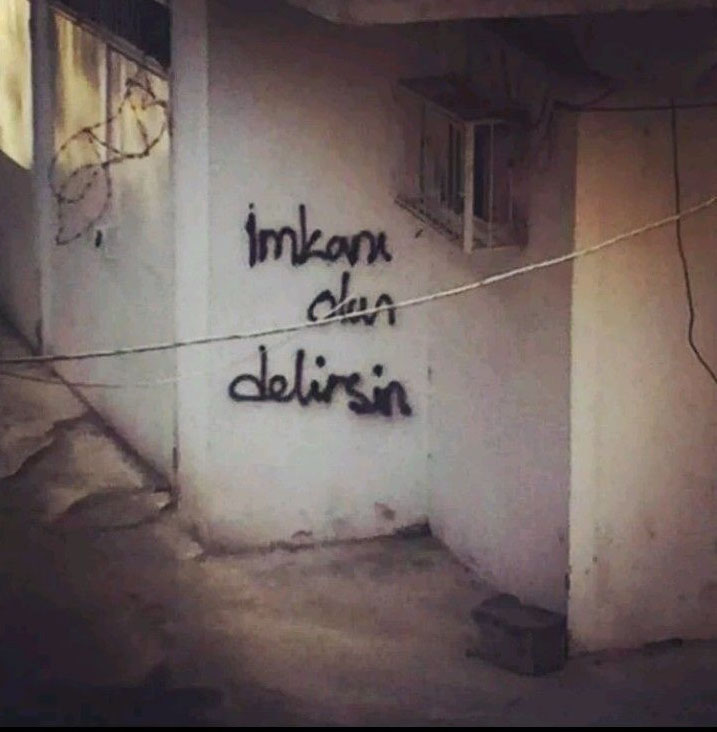
Ülker pointed out:
Several years ago, a slogan began to appear on the walls of Istanbul’s streets, which can be translated as “those who have the means, go mad”. Even though people want to resort to madness, they have pressing responsibilities like waking up at 7 am to go to work, working for 10 hours a day and six days a week, paying their credit card debts, cooking for their children, and caring for their parents.
I cannot tell if all of us went mad but thusly, we stayed .
In 2016, Füsun Üstel, who was later imprisoned for signing the peace petition, wrote a mesmerizing essay in Birgün Pazar and I jotted down her sentences in a notebook:
I am more interested in the milieu of the spirit, wherein the options of leaving and staying are being discussed more and more. In an environment where lives are turned upside down in an instant, "going" is no less valuable than staying. The answer to the question "We shall stay, but how?" is more complex. It requires daily effort. After all, we are busy minding our work. We are bewildered by the rise of an unfamiliar world. At times we lose hope. On the inside, we are hovering on the edge of becoming emigrants. How will we cope?
Üstel referred to “Inner emigrants” (Innere Emigranten): those who preferred to stay in Nazi Germany without cooperating with the regime. It was a “claim to resist the regime, albeit implicitly, by staying outside the official understanding of culture and art, by turning to new forms of expression.” Indeed, we felt and lived like inner emigrants. Political groups fell apart, social movements regressed, and silence prevailed. I remember visiting the Kurdish “capital” Amed in 2016 and sensing for the first time the heaviness and stillness hanging in the air. For the first time, I thought, Istanbul and Amed, the two capitals of the west and east of turkey, two cities with totally different political temperaments, felt the same melancholic vibe of political defeat.
“When resignation and melancholy follow the ecstasy of the event, as when love’s excitement dulls under the force of habit, it becomes absolutely essential not to adjust yourself to the moments of fatigue”, wrote Bensaid.
We told each other to go about our lives and encouraged each other to do the best we could: keep on researching, keep on writing, keep on producing, we said. Be resilient! And we did what we could.
Endless and heated political meetings we used to have till only a couple of months prior got smaller and smaller and eventually, I stopped participating. We opted for getting together to just talk about how and what we felt instead. These were like the small feminist consciousness-raising meetings where women from different walks of life used to try to figure out how they experienced patriarchy in their everyday lives. We were trying to figure out what this regime (fascism? Authoritarianism? totalitarianism? Neo-fascism?) was doing to us. In one of these get-togethers, Meltem used the term “undigested experience” to describe the situation: one cannot chew on what one goes through, let alone digest it as an experience. I recall I talked briefly about how fermenting yogurt kept me sane. I was fascinated by bacteria that reproduce themselves endlessly. Reproduction at its best, I thought, and what an effortless way of staying alive.
Cyclical protests were another way of staying sane and seizing the present. The 18 th annual “Istanbul Feminist Night March” of 2020 had a rather extraordinary atmosphere. Aylin and I wrote:
We were in the streets for the Feminist Night March on 8 March, exactly three days before the first Covid-19 case was officially announced in Turkey. The protest, banned by the Governorship of Istanbul, started slowly, with small groups gathering on Sıraselviler Street. We had our eyes set on the police barricade erected at the entrance to the street; we were all ears for the engine of the anti-riot water cannon parked behind us. A placard read, “Patriarchy is deadlier than Corona.” During our first minutes in the crowd, we wondered, with the virus in mind, “Should we cover our mouths with our jackets?” Yet this slight anxiety dissipated into shouted slogans in no time: “We are not leaving the nights, the streets, and the squares!” We were not aware that this would be the last protest we would join for some time even though one of the banners had warned us: “If you feel despair, remember this crowd!” it said.
The promise
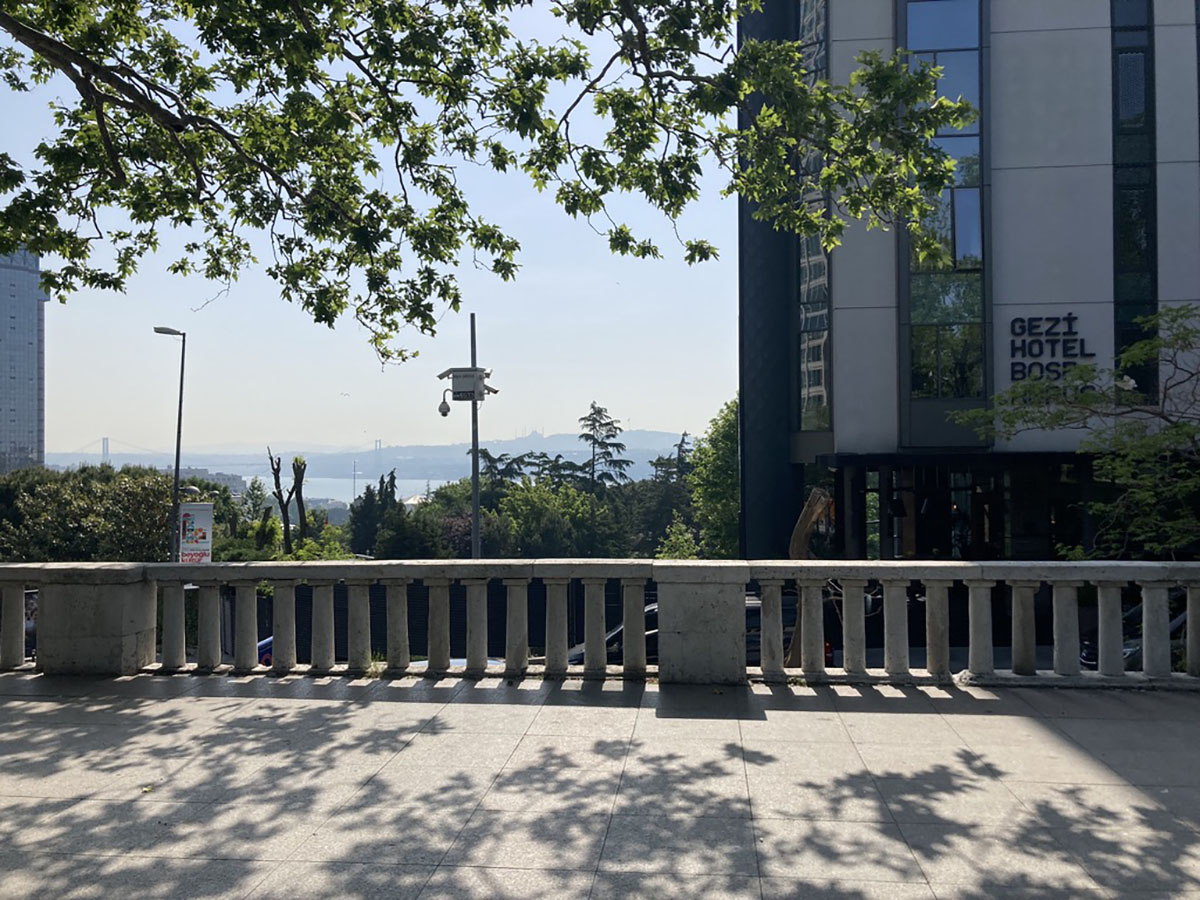
In 2022, while strolling from Taksim back home, I stopped by Gezi Park and visited the exact same point where the “our commons” networks’ tent was set up. As I stood there, I realized for the first time that there was a view of the Bosporus. Our tent had turned its back on one of the most beautiful views of the world, so as to face the occupied park instead. And now, it occurred to me, alongside the park, that “the view” was also saved. It was and will be there for anyone who happens to pass by to enjoy for free. We had turned our back to the Bosporus in order to save it. We had won. It seemed to me that small victories like that needed to be acknowledged.
Enzo Traverso argues that:
Rather than a regime or an ideology, the lost object can be the struggle for emancipation as a historical experience that deserves recollection and attention in spite of its fragile, precarious, and ephemeral duration. In this perspective, melancholy means memory and awareness of the potentialities of the past: a fidelity to the emancipatory promises of revolution, not to its consequences.
In an interview, Caner asked me what I thought the promise of Gezi was. Here’s how I responded:
Let's start by thinking about what the promise of an uprising or a popular movement can be. This is the kind of theorizing we do only after a movement has disappeared or the wave has receded, so to speak. Such major uprisings often produce new modes of organization and action, new ways of doing, and new forms of subjectivity. In my opinion, if we want to generate ideas and actions based on the political horizon of Gezi, we should start from the experience of the two weeks in which the Park was occupied. During the occupation, different aspects of everyday life, from cooking to staging an opera, were organized outside of market relations and the state. The political horizon opened up by Gezi requires us to think about forms of organization, ways, and methods that will enable us to autonomously organize our daily lives and democratically make decisions outside the market and the state. This is a political horizon that has not yet been named.
As I write this text, looking at the view of the Bosporus from the Atatürk Library, I feel like we are standing at a certain threshold between a past—which lies in ruins in both the literal and metaphorical senses—and a future to come. The recent earthquake killed thousands and destroyed 11 cities. In May, the general and presidential elections will be held. I just filled in the form to volunteer to monitor elections. 2023 is the 10th anniversary of the Gezi uprising and the 100 th anniversary of the founding of the Republic of Turkey. The past and the future should now be redeemed.